Neurobiological structure
- Self-Management to Time
dlPFC, Cerebellum, Fronto-Striatal Circuits, SMA
- Self-Organisation & Problem Solving
dlPFC, Frontoparietal Network, Caudate
- Self-Restraint
Right Inferior Frontal Gyrus, ACC, Basal Ganglia
- Self-Motivation
VTA, Nucleus Accumbens, vmPFC, OFC
- Self-Regulation of Emotion
Amygdala, vmPFC, ACC, Insula
Neurobiological Summary
From a modern ADHD perspective, the BDEFS domains reflect dysfunction across three major interacting systems:
Executive Control Network
- dlPFC
- Frontoparietal network
- ACC
Reward and Motivation Network
- Ventral striatum
- Nucleus accumbens
- Dopamine pathways
- OFC/vmPFC
Emotional Regulation Network
- Amygdala
- Insula
- vmPFC
- ACC
Underlying all three systems is dopaminergic dysregulation within frontostriatal, reward, and executive control circuits, which helps explain why adults with ADHD often show difficulties across all five BDEFS domains rather than in attention alone.
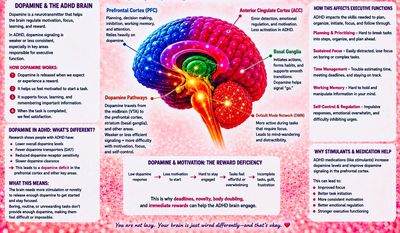
Basal Ganglia
Basal Ganglia
Basal Ganglia
(Striatum: Caudate and Putamen)
motivation, reward, and action regulation
Location: Deep subcortical structures near the centre of the brain.
- In ADHD, the brain’s reward system is more strongly driven by what feels interesting, urgent, or immediately engaging, rather than by what is important in the long term.
- This means tasks that are boring, repetitive, or have delayed rewards (e.g., paperwork, admin, long-term projects) can feel much harder to start and sustain, even when the person knows they matter.
- In contrast, tasks that are stimulating, novel, or time-pressured can be completed with high focus and energy.
- As a result, motivation can appear inconsistent—strong in some situations and very low in others—which is often misunderstood as laziness, but actually reflects how the brain processes reward and effort.
Primary functions
- Regulation of motor activity and restlessness
- Action selection and behavioural inhibition
- Habit formation and procedural learning
- Reward processing and reinforcement learning
- Filtering of competing stimuli and responses
Neurobiological basis::
- This system is highly dependent on dopaminergic signalling, particularly within fronto-striatal circuits
- Dopamine modulates the salience of rewards, effort allocation, and the initiation or suppression of behaviour
ADHD-related deficits
- Impaired behavioural inhibition and increased impulsivity
- Reduced capacity to sustain effort for tasks with delayed or abstract reward
- Heightened sensitivity to immediate reward, novelty, urgency, and stimulation
- Difficulty shifting behaviour in response to changing rules or contingencies
- Restlessness or a subjective sense of being internally “driven” to move
Structural and functional findings
- Neuroimaging studies frequently demonstrate reduced volume in basal ganglia structures, particularly the caudate nucleus, in individuals with ADHD
- Functional dysregulation within these circuits contributes to altered reward sensitivity and inefficient action selection

Working Memory
Working Memory
Working memory in ADHD is associated with functional differences across a distributed fronto-striatal–parietal network, including the dorsolateral prefrontal cortex, anterior cingulate cortex, basal ganglia, parietal cortex, and cerebellum. These differences result in impaired maintenance and manipulation of information over time, particularly under conditions of stress, distraction, or cognitive load, and account for core DSM-5 inattentive symptoms observed in adults with ADHD.
Working Memory: Key Brain Areas (and ADHD)
1. Prefrontal Cortex (PFC)
Primary region for working memory
- Especially the dorsolateral prefrontal cortex (DLPFC)
- Responsible for:
- Holding information “online”
- Manipulating information
- Guiding behaviour based on goals and future intentions
ADHD findings
- Reduced activation and efficiency during working memory tasks
- Difficulty sustaining neural firing needed to keep information active
- Highly sensitive to stress, fatigue, and emotional load
Clinical correlate
- Forgetting what one was about to do
- Losing track mid-task
- “Out of sight, out of mind”
2.Anterior Cingulate Cortex (ACC)
Attention control and error monitoring
- Integrates cognition and emotion
- Helps decide:
- What to focus on
- What to ignore
- When effort needs to increase
ADHD findings
- Reduced activation → poor effort regulation
- Difficulty sustaining mental effort over time
- Increased emotional interference with cognition
Clinical correlate
- Inconsistent performance
- Mental fatigue
- Emotional dysregulation worsening forgetfulness
3. Parietal Cortex (especially Posterior Parietal Cortex)
Storage + attentional workspace
- Supports:
- Temporary storage of information
- Shifting and updating attention
- Spatial and sequential working memory
ADHD findings
- Reduced coordination with PFC
- Difficulty updating or refreshing information
- Vulnerability to distraction
Clinical correlate
- Losing track of instructions
- Difficulty juggling multiple steps
- Problems with sequencing and planning
4. Basal Ganglia (especially Striatum)
Gating system for working memory
- Dopamine-dependent “gatekeeper”
- Determines:
- What information gets into working memory
- What gets dropped
ADHD findings
- Dopaminergic dysregulation
- Inefficient gating → either:
- Too much irrelevant information, or
- Failure to hold relevant information
Clinical correlate
- Distractibility
- Mental clutter
- Benefit from stimulant medication (dopamine ↑ → gating improves)
5. Cerebellum
Timing, prediction, and coordination
- Modulates:
- Timing of cognitive processes
- Predictive control
- Automation of routines
ADHD findings
- Structural and functional differences
- Poor temporal coordination of working memory processes
Clinical correlate
- Time blindness
- Poor estimation of task duration
- Difficulty anticipating future steps

Self Management to Time
1. Self-Management to Time
Core Function
Using time to guide behaviour toward future goals.
Russell A. Barkley
’s “Internalisation of Time” Network
- Dorsolateral Prefrontal Cortex (dlPFC)
- Planning
- Holding future goals in mind
- Time estimation
- Fronto-Striatal Circuits
- Coordination of goal-directed behaviour
- Tracking progress toward future rewards
- Cerebellum
- Internal timing
- Temporal sequencing
- Estimation of duration
- Supplementary Motor Area (SMA)
- Timing and sequencing of actions
ADHD Manifestations
- Time blindness
- Chronic lateness
- Poor planning
- Difficulty anticipating future consequences
- Last-minute task completion

Self Organisation
2. Self-Organisation and Problem Solving
Core Function
Planning, organising, sequencing, and solving problems.
Key Brain Regions
Dorsolateral Prefrontal Cortex (dlPFC)
The primary executive control region responsible for:
- Planning
- Organisation
- Working memory
- Complex reasoning
Frontoparietal Network
Includes:
- dlPFC
- Posterior Parietal Cortex
Supports:
- Mental organisation
- Multi-step problem solving
- Attention allocation
Caudate Nucleus
Part of the basal ganglia involved in:
- Cognitive control
- Organising behaviour
- Goal-directed action
ADHD Manifestations
- Disorganisation
- Losing items
- Difficulty managing multiple tasks
- Problems sequencing actions
Self Restraint
3. Self-Restraint
Core Function
Inhibiting impulses and stopping inappropriate responses.
Key Brain Regions
Right Inferior Frontal Gyrus (rIFG)
The brain’s primary inhibitory control centre.
Responsible for:
- Stopping responses
- Suppressing impulses
- Behavioural inhibition
Anterior Cingulate Cortex (ACC)
Monitors:
- Errors
- Conflict detection
- Behavioural adjustment
Basal Ganglia
Particularly:
- Caudate
- Putamen
- Subthalamic nucleus
Supports:
- Response inhibition
- Action selection
ADHD Manifestations
- Interrupting
- Impulsive decisions
- Talking excessively
- Acting without thinking
Self regulation of emotions
5. Self-Regulation of Emotion
Core Function
Managing emotional reactions and recovering from emotional activation.
Key Brain Regions
Amygdala
Responsible for:
- Threat detection
- Emotional salience
- Emotional intensity
In ADHD:
- Often demonstrates increased reactivity
Ventromedial Prefrontal Cortex (vmPFC)
Helps:
- Regulate emotional responses
- Reappraise emotional situations
Anterior Cingulate Cortex (ACC)
Supports:
- Emotional monitoring
- Emotional conflict resolution
Insula
Processes:
- Emotional awareness
- Internal bodily sensations
- Social pain
ADHD Manifestations
- Emotional dysregulation
- Irritability
- Frustration intolerance
- Rejection Sensitivity Dysphoria (RSD)
- Emotional impulsivity
Why Rejection Sensitivity happens
Rejection Sensitivity Dysphoria (RSD) in Attention-Deficit/Hyperactivity Disorder (ADHD)
reflects altered neural processing of :
social threat, emotional salience, and regulation, rather than a discrete diagnostic entity.
It arises from functional and connectivity differences across fronto-limbic, salience, and reward networks.
1. Amygdala: Heightened Threat Detection
The amygdala plays a central role in detecting threat and assigning emotional salience, particularly to social cues such as criticism, exclusion, or perceived disapproval.
- In ADHD, the amygdala demonstrates hyper-reactivity to emotionally salient stimuli
- Neutral or ambiguous interpersonal cues may be misinterpreted as rejection or failure
- This contributes to the rapid onset and intensity of emotional pain characteristic of RSD
Importantly, this response is fast and reflexive, occurring before higher-order cognitive appraisal.
2. Prefrontal Cortex (PFC): Impaired Top-Down Regulation
The prefrontal cortex—particularly the dorsolateral (dlPFC) and ventromedial (vmPFC) regions—modulates emotional responses generated by the limbic system.
In ADHD:
- Reduced PFC activation limits inhibitory control over amygdala output
- Emotional responses are less filtered, less contextualised, and harder to down-regulate
- Individuals may intellectually “know” a response is disproportionate but cannot dampen it in real time
This explains why RSD is often described as overwhelming, uncontrollable, and physically painful.
3. Anterior Cingulate Cortex (ACC): Pain and Social Error Processing
The anterior cingulate cortex integrates emotional pain, cognitive conflict, and social evaluation.
- The ACC is involved in both physical pain and social pain processing
- In ADHD, ACC dysregulation contributes to:
- Intensified distress following perceived rejection
- Heightened sensitivity to interpersonal mistakes or disapproval
- Persistent rumination on social “errors”
This shared circuitry helps explain why rejection in RSD is often described as visceral rather than merely
4. Dopaminergic Reward Pathways: Salience Without Stability
ADHD is associated with dopaminergic dysregulation in fronto-striatal circuits, including the nucleus accumbens.
- Dopamine modulates reward prediction, motivation, and emotional salience
- In ADHD, inconsistent dopamine signalling leads to:
- Over-weighting of negative feedback
- Reduced buffering from prior positive experiences
- Difficulty maintaining emotional equilibrium after criticism
As a result, rejection signals carry disproportionate motivational and emotional weight.
5. Default Mode Network (DMN): Internalisation and Rumination
The default mode network, active during self-referential thought, shows atypical regulation in ADHD.
- Increased DMN intrusion during emotional states promotes:
- Self-blame (“I’ve failed”, “I’m not good enough”)
- Retrospective replay of social interactions
- Prolonged emotional activation after the triggering event
This sustains RSD responses well beyond the initial interpersonal cue.
Integrated Neurobiological Model of RSD in ADHD
RSD reflects the convergence of:
- Hyper-reactive threat detection (amygdala)
- Insufficient top-down emotional inhibition (PFC)
- Amplified social pain signalling (ACC)
- Dopaminergic salience imbalance
- Excessive self-referential processing (DMN)
Together, these systems produce rapid, intense, and enduring emotional responses
to perceived rejection, often without conscious control.
- RSD is not a character flaw or over-sensitivity
- It represents a neurodevelopmentally mediated emotion-regulation vulnerability
- Effective management often requires:
- ADHD-specific pharmacotherapy (to improve fronto-striatal modulation)
- Skills targeting emotional regulation and cognitive reappraisal
- Psychoeducation to reduce shame and self-blame

Working Memory
What is Working Memory?
Working memory is the brain’s mental workspace. It is the ability to hold information in mind for a short period of time while using or manipulating that information to complete a task.
Unlike long-term memory, which stores information for days or years, working memory only keeps information active for a few seconds unless you actively rehearse or use it.
Think of working memory as the RAM in a computer.
- Long-term memory is the hard drive where information is stored.
- Working memory is the RAM where information is temporarily held while you work with it.
If the brain’s “RAM” becomes overloaded or inefficient, information is easily lost before the task is finished.
Everyday examples of working memory
Working memory allows you to:
- Remember a phone number long enough to dial it.
- Follow multi-step instructions without forgetting the next step.
- Keep track of what someone is saying during a conversation.
- Perform mental arithmetic.
- Remember why you walked into a room.
- Hold your place while reading.
- Remember what you intended to say while someone else is talking.
- Cook a meal while keeping track of several steps at once.
What happens in ADHD?
In ADHD, working memory is often less efficient because the brain has difficulty keeping information active in awareness.
This can lead to:
- Forgetting what you were doing after an interruption.
- Losing track of conversations.
- Walking into a room and forgetting why.
- Frequently misplacing belongings.
- Needing to write everything down.
- Forgetting appointments despite intending to remember.
- Losing your place during reading or paperwork.
- Difficulty following multi-step instructions.
- Starting a task and forgetting the original goal.
- Feeling mentally overloaded when several things require attention simultaneously.
Importantly, this is not a problem with intelligence. Many people with ADHD have excellent reasoning ability, but their “mental workspace” has a reduced capacity or is more easily disrupted by distraction.
What parts of the brain are involved?
Working memory relies on a network of brain regions, including:
- Dorsolateral Prefrontal Cortex (DLPFC): Holds and manipulates information “online.”
- Frontoparietal Network: Directs attention and coordinates information.
- Anterior Cingulate Cortex (ACC): Monitors performance and helps maintain focus.
- Basal Ganglia (especially the Caudate): Helps update and filter information entering working memory.
- Cerebellum: Contributes to timing and sequencing of cognitive processes.
These regions communicate using neurotransmitters such as dopamine and noradrenaline, both of which help maintain stable attention and keep relevant information active.
Working memory is primarily supported by a network of brain regions, rather than a single area. In ADHD, several of these regions function less efficiently, particularly when dopamine and noradrenaline signalling is reduced.
1. Prefrontal Cortex (Main Working Memory Centre)
The prefrontal cortex, especially the dorsolateral prefrontal cortex (DLPFC), is the brain’s main “working memory system.”
It is responsible for:
- Holding information in mind for short periods.
- Keeping attention focused on relevant information.
- Planning and organising.
- Mentally manipulating information (for example, doing calculations in your head).
- Resisting distractions while remembering what you were doing.
In ADHD, this region is often less active and has less efficient dopamine and noradrenaline signalling, making it harder to keep information “online.”
2. Anterior Cingulate Cortex (ACC)
The anterior cingulate cortex helps:
- Maintain attention.
- Detect errors.
- Monitor performance.
- Decide what information is important enough to keep active.
When the ACC is less efficient, attention is more easily diverted, and information being held in working memory can be lost.
3. Basal Ganglia
The basal ganglia, particularly the caudate nucleus, act as a gatekeeper.
They help:
- Filter out irrelevant information.
- Select what should enter working memory.
- Support smooth communication between the prefrontal cortex and the rest of the brain.
Differences in this network are consistently found in ADHD.
4. Parietal Cortex
The parietal cortex works with the prefrontal cortex to:
- Store information temporarily.
- Maintain spatial information.
- Support mental calculations.
- Help keep track of multiple pieces of information.
5. Cerebellum
Although traditionally associated with movement, the cerebellum also contributes to:
- Timing.
- Sequencing.
- Mental coordination.
- Keeping cognitive processes running smoothly.
It helps the working memory system operate efficiently.
Think of working memory as a team:
- Prefrontal cortex = the manager that holds information in mind.
- Anterior cingulate cortex = the supervisor that keeps attention on the task.
- Basal ganglia = the gatekeeper that decides what information gets through.
- Parietal cortex = the temporary storage area.
- Cerebellum = the timing coordinator that keeps everything running smoothly.
In ADHD, these regions still work, but communication between them is often less efficient because dopamine and noradrenaline signalling is less effective.
As a result, information is more easily lost from working memory, particularly during distractions, interruptions, or tasks that are repetitive or uninteresting.
This network-based explanation is well supported by modern neuroimaging research and aligns with current models of ADHD as a disorder of frontostriatal and frontoparietal brain networks.
Working Memory
- Working memory is the brain’s ability to hold information in mind and use it over short periods of time.
- It acts like a mental workspace that helps us follow instructions, complete tasks, and keep track of what we are doing.
How Dopamine Affects Working Memory
- Helps the prefrontal cortex maintain information “online.”
- In ADHD, less efficient dopamine signalling can make information fade more quickly, resulting in forgetfulness, distractibility, and difficulty completing complex tasks.
In ADHD:
- Information is more easily lost from conscious awareness.
- Difficulty holding multiple pieces of information in mind at once.
- Forgetting what you were about to say or do.
- Losing track of tasks after interruptions.
- Difficulty following multi-step instructions.
- Frequently misplacing items and forgetting appointments.
- Increased reliance on reminders, notes, and external prompts.
Brain Regions Involved:
- Prefrontal Cortex (PFC) – temporarily stores and manipulates information.
- Frontostriatal Networks – support attention and task maintenance.
- Dopamine Pathways – help keep information active and available in working memory.
Working Memory Difficulties in ADHD
Attention & Concentration
- Losing track of conversations
- Forgetting what someone just said
- Difficulty following lengthy discussions
- Needing instructions repeated
- Losing focus after interruptions
- Forgetting what was being done before becoming distracted
- Reading without retaining information
- Difficulty taking notes while listening
Planning & Organisation
- Difficulty holding multiple steps in mind
- Forgetting parts of a plan
- Losing track of priorities
- Difficulty organising complex tasks
- Forgetting deadlines and appointments
- Struggling to anticipate future needs
- Difficulty coordinating several tasks simultaneously
Task Completion
- Starting tasks and forgetting to finish them
- Forgetting the next step in a sequence
- Leaving tasks partially completed
- Moving between tasks without completing either
- Difficulty following recipes, instructions, or procedures
- Forgetting why a task was started
Time Management
- Forgetting scheduled commitments
- Losing track of time
- Underestimating how long tasks will take
- Missing deadlines
- Forgetting future intentions
- Difficulty planning ahead
Memory & Recall
- Frequently misplacing items
- Forgetting names shortly after hearing them
- Forgetting phone numbers, passwords, or codes
- Forgetting what was needed from a shop
- Walking into a room and forgetting why
- Forgetting what you intended to say mid-conversation
- Losing thoughts before expressing them
Emotional Regulation
- Difficulty remembering coping strategies when upset
- Reacting impulsively before considering consequences
- Difficulty holding perspective during emotional situations
- Becoming overwhelmed when managing multiple demands
- Increased frustration when information is lost
Self-Monitoring
- Forgetting personal goals
- Losing track of progress on tasks
- Difficulty monitoring performance
- Forgetting mistakes and repeating them
- Difficulty evaluating behaviour in real time
Social Functioning
- Forgetting details from conversations
- Forgetting birthdays or important events
- Losing track of conversational topics
- Interrupting because of fear of forgetting a thought
- Difficulty remembering social commitments
- Missing social cues while trying to hold information in mind
Learning & Academic Performance
- Difficulty following multi-step instructions
- Forgetting information while solving problems
- Difficulty performing mental calculations
- Poor retention of newly learned material
- Difficulty taking information from one context and applying it to another
- Problems with note-taking while listening
Everyday Life Examples
- Forgetting keys, phone, wallet, glasses, medications
- Leaving items behind when leaving home
- Starting household chores and becoming distracted
- Forgetting items on a shopping list
- Missing bills or paperwork
- Difficulty managing finances
- Forgetting where objects were placed moments earlier